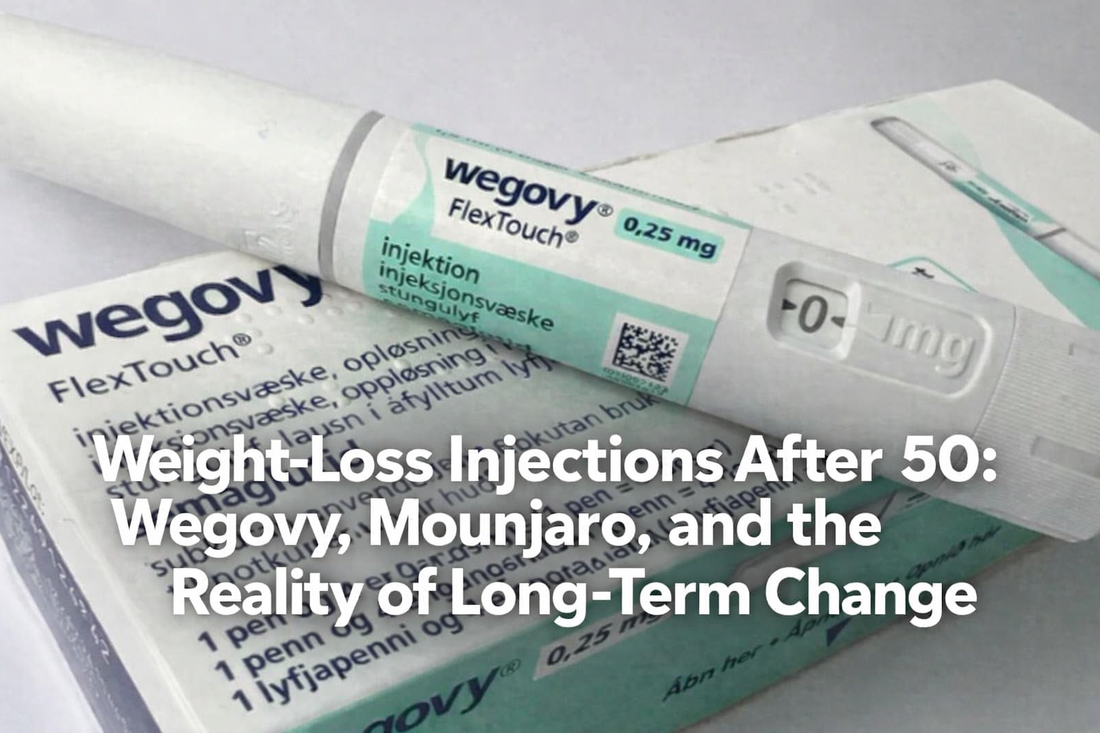
Weight-Loss Injections After 50: Wegovy, Mounjaro, and the Reality of Long-Term Change
Weight-loss injections have become one of the most talked-about tools in modern health care. For some people they’re a turning point; for others they’re confusing, expensive, and surrounded by noise. If you’re over 50, the conversation matters even more—because the goal isn’t just “losing weight.” It’s keeping strength, energy, confidence, and function while you do it.
This guide explains the main types of injections, then focuses on Wegovy and Mounjaro: why people use them, the genuine advantages and disadvantages, and what typically happens if you stop. It finishes with the most important principle of all: if you don’t change lifestyle, most people drift back toward their original condition—meaning many will need long-term treatment to maintain results.
Educational content only. This is not medical advice and does not replace care from a qualified clinician.

Why weight loss after 50 is a different job
If you’re over 50 and thinking, “This used to be easier,” you are not imagining it. Mid-life weight gain is often the result of several overlapping shifts—not one simple cause. Common drivers include gradual loss of muscle mass, hormone changes (especially around menopause), changes in recovery capacity, increased insulin resistance, disrupted sleep, and stress load.
The over-50 challenge is rarely a lack of information. Most people already know what “healthy eating” looks like. The challenge is that appetite can feel louder, energy can feel lower, and the body can become more protective of its weight than it was in earlier decades.
This is why weight-loss injections have become so appealing: they can reduce appetite and “food noise,” giving you a calmer, more manageable starting point. But they don’t remove the realities of ageing. In fact, they make some of them more important—especially protecting muscle.
The main types of weight-loss injections
“Weight-loss jabs” is a broad phrase. Clinically, these are prescription medicines that influence appetite, satiety, and metabolic signalling. They are not cosmetic shortcuts and they are not fat burners. They work by changing the hormonal conversation between your gut and your brain.
1) GLP-1 receptor agonists
These mimic a naturally occurring hormone called GLP-1 (glucagon-like peptide-1) which rises after eating. In simple terms, GLP-1 helps you feel full sooner and for longer. GLP-1 medicines typically:
- reduce appetite and cravings
- slow gastric emptying (food leaves the stomach more slowly)
- improve blood-sugar control (especially relevant for insulin resistance and type 2 diabetes)
2) Dual-agonist injections
Newer medications act on more than one hormone receptor. The best-known example targets GLP-1 plus another hormone pathway involved in glucose and appetite regulation. The dual mechanism can produce stronger average weight loss for many users, but also tends to deliver stronger appetite suppression—meaning nutrition quality becomes even more important.
3) Other prescription weight-loss medicines (some injectable, many oral)
There are other weight-management medications with different mechanisms (some reduce fat absorption, some act centrally on appetite). They exist, but the current conversation—especially for over-50s—centres on GLP-1 medicines and dual-agonists because the results tend to be more significant for more people.

Wegovy vs Mounjaro: what they are and how they differ
Both Wegovy and Mounjaro are weekly injections. Both can reduce appetite and improve metabolic markers. The key difference is the hormone pathways they target.
| Feature | Wegovy | Mounjaro |
|---|---|---|
| Active ingredient | Semaglutide | Tirzepatide |
| Type | GLP-1 receptor agonist | Dual agonist (GLP-1 + another incretin pathway) |
| Typical dosing | Once weekly, titrated upward over time | Once weekly, titrated upward over time |
| Weight loss (typical trial averages) | Often in the 10–15% range for many users (varies) | Often higher on average (commonly mid-teens to ~20% range) |
| Common side effects | GI upset (nausea, reflux, constipation/diarrhoea), especially during dose increases | Similar GI profile; appetite suppression can feel stronger for some people |
The practical takeaway: Mounjaro’s dual action may produce more weight loss for many people, but it does not change the fundamentals. Over 50, your best “results insurance policy” is still the same: adequate protein, strength training, and sustainable routines.
Also worth noting: access, prescribing rules, and cost vary by country and clinic. The “best” option is often the one that is medically appropriate, available to you, and supportable long-term.
Why people use Wegovy or Mounjaro
People rarely choose these medications because they’re “lazy.” Most arrive here after years of effort and frustration. Common reasons include:
1) Appetite feels like the real problem
Many people can eat well for a while, but hunger and cravings eventually become relentless. These injections can reduce appetite to a level that feels normal, not obsessive. For some, it is the first time in years they’ve experienced quiet around food.
2) Mid-life physiology has changed
After 50, weight is often more tightly defended by the body. Hormonal shifts, sleep disruption, lower recovery capacity, and insulin resistance can turn weight loss into a grind. Medication can reduce the biological friction.
3) Health risk feels more urgent
Over-50 decisions are often driven by joint pain, mobility, blood pressure, blood sugar, sleep apnoea risk, or family history. The goal becomes “reduce risk and feel better,” not “fit into an old pair of jeans.”
4) They want a window for change
A key reason people do well on these medications is that appetite suppression creates space to build routines: meal structure, protein consistency, strength training, sleep discipline. The medication doesn’t build the habits—but it can make them easier to start.
Advantages (especially after 50)
Used appropriately, these injections can offer meaningful benefits. The biggest advantages are not just “weight loss,” but what comes with it: improved metabolic health, better mobility, and a calmer relationship with food.
1) Clinically meaningful weight loss while you’re on treatment
For many users, weight loss is significant enough to improve joint pain, stamina, and everyday comfort. For over-50s, even modest reductions can translate into meaningful changes in movement and quality of life.
2) Less “food noise” and fewer cravings
A quieter appetite often means less constant negotiation: fewer impulsive snacks, fewer “I’ll start Monday” cycles, and more space to make deliberate choices.
3) Improvements in health markers (for many people)
Many people see improvements in blood sugar control, insulin sensitivity, blood pressure, or lipids alongside weight loss. That is one reason clinicians view these medicines as part of medical risk management, not simply cosmetic tools.
4) A window of opportunity to build strength-based habits
Over 50, your best long-term strategy is not “less food.” It is “more muscle.” If medication reduces appetite, you can use the window to build a routine that protects strength, bone health, and independence.
Disadvantages, risks, and what people don’t say out loud
These medications are powerful, which means trade-offs matter. For over-50s, the biggest risks are not only side effects. They include muscle loss, under-nutrition, cost, and the “maintenance reality” if you ever stop.
1) Gastrointestinal side effects (common)
Nausea, reflux, bloating, constipation, and diarrhoea are common—especially during dose increases. Many people improve with time and slower titration, but some find side effects disruptive enough to stop.
2) Muscle loss risk (the over-50 headline)
When appetite drops, people often eat less protein and move less—especially if they feel tired. Rapid weight loss without resistance training can reduce lean mass. Over 50, this matters because muscle is tied to metabolic health, balance, injury resilience, and long-term independence.
Over-50 non-negotiables while using injections
- Protein at every meal (because appetite may not remind you)
- Resistance training 2–4x/week (even if it’s short and joint-friendly)
- Hydration + fibre (to support digestion and energy)
3) Cost and access (the practical barrier)
Many people can start a medication, but fewer can sustain it long-term if it is self-funded. Because maintenance often requires ongoing treatment, financial realism must be part of the plan from day one.
4) Psychological reliance (subtle but real)
Some people fear stopping so much that they never build confidence in their own routines. The most successful users treat medication as a support, not an identity. The goal is capability: “I can keep this going,” not “I can only do this if I’m medicated.”
What happens when you stop taking Wegovy or Mounjaro?
This is the question that decides whether injections are a “short-term kickstart” or a “long-term treatment.” In most cases, when you stop, the appetite support fades and biology gradually returns toward baseline.
1) Hunger and cravings tend to return
Many users notice that the quiet appetite they enjoyed on medication begins to lift. Portion sizes can creep up, snacking can return, and “food noise” can become louder again. This is not weakness; it is physiology.
2) Weight regain is common without lifestyle change
If habits did not change while the medication was working, weight regain is common. Some people regain a portion; others regain most of what was lost. The more your results depended on appetite suppression alone, the more likely you are to drift back toward your starting point.
3) Health markers can drift back too
Improvements in blood sugar, blood pressure, and lipids often track with body weight and routine. If weight and habits revert, those markers can move back in the wrong direction over time.
So do you have to stay on them for life?
For many people, the honest answer is: possibly. Not because you “failed,” but because obesity and weight dysregulation are often chronic. These medicines are increasingly viewed like other long-term treatments: effective while used, and less effective when removed.
Some people can reduce dose or stop and maintain much of their progress—but usually only if they used the window to build a strong lifestyle foundation: protein, strength training, daily movement, sleep discipline, and routine consistency.

The smartest approach after 50: use the window well
Here’s the simplest, most useful way to frame these injections: the medication creates an opportunity; lifestyle determines the outcome. If appetite is quieter, you can build the routines that will protect you when appetite returns.
That’s why we created a dedicated page for over-50s using weight-loss injections—focused on the fundamentals that matter most: muscle protection, nourishment, recovery, focus, and support.
Start here: Using the Window Well
A practical five-part structure to help you use appetite suppression strategically—without losing strength, and without relying on hope as a plan.
Using The Window WellYour over-50 “maintenance insurance” checklist
- Strength train (protect lean mass; support long-term metabolism)
- Protein first (especially when appetite is low)
- Move daily (steps, mobility, light conditioning)
- Sleep like it matters (because it controls appetite and consistency)
- Plan for plateaus and change (dose adjustments, availability, stopping)
If you do nothing else, do those. They are not glamorous, but they are the difference between “weight loss” and “a new normal.”
FAQ: quick answers for over-50s
Is it “cheating” to use injections?
No. Obesity and weight dysregulation involve biology, hormones, and environment. Using a medically supervised tool is not cheating. The real question is whether you’re using the tool to build a life you can sustain.
Can I use them short-term just to kickstart weight loss?
Some people do, but short-term use without lifestyle change often leads to regain. If you plan to stop, you need a maintenance strategy before you start: protein, strength training, and routines you can keep when appetite returns.
What if I can’t do heavy strength training?
You don’t need heavy. You need consistent. Bodyweight work, resistance bands, machines, and joint-friendly strength sessions all count. The aim is preserving muscle and function, not becoming a competitive lifter.
What side effects should I watch?
Many people experience gastrointestinal side effects, especially during dose increases. Persistent or severe symptoms should always be discussed with your clinician. Never ignore significant abdominal pain, dehydration, or symptoms that feel alarming.
What’s the most important success factor after 50?
Protecting muscle. The scale can go down while health goes sideways if you lose strength. Over-50 success is fat loss with function intact.
The bottom line
Wegovy and Mounjaro can be effective tools—especially when mid-life biology is pushing back. But they are not a permanent fix on their own. If you do not change lifestyle, most people trend back toward their starting point after stopping, which is why many will require long-term treatment to maintain results.
The best approach is to treat appetite suppression as a window, not a destination. Use it to build the basics that make results durable: protein, strength, daily movement, sleep, and support.
Use the window well: start hereReminder: This content is informational and does not replace medical advice. For individual guidance, consult a qualified clinician.